Fittingly, this new cradle of modern watch making was the location chosen by Renaud de Retz, Guillaume Tetu and Jean Plazenet to make their dream of creating a new line of watches become a reality. These three enthusiasts decided to combine their creative, technical and design skills to give rise to a brand that thrives on the cutting edge of technology yet remains loyal to the steeped philosophy of traditional watch making. As a testament to the intertwined destiny of the newly forged brand to that of the city where it is rooted, the creators decided to take an anagram of Neuchâtel for its name - HAUTLENCE.

Neuchâtel
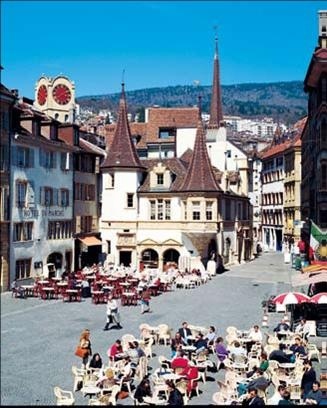
Place des Halles
The thought of being where the headquarters ought to be was one thing; proving such a notion became the next challenge. Armed with a plethora of strong ideas regarding new approaches to time display and the willingness to explore new horizons in mechanical conceptions, the brand began accumulating the necessary means to create a watch worthy of the HAUTLENCE name and be marked with its chosen logo, the Mobius band, the sign of everlasting time without beginning or end. Each piece that carries this symbol represents the manufacturer‘s commitment that every watch it brings to life is a certified masterpiece. In line with this ethos, as well as the desires of the creators, the company has decided to manufacture its own movement. This point was driven home before any watch left the drawing board. It was observed that certain parts such as the guided linear bearings of the connecting rod assembly, the inertia block of the jumping hour directly integrated into the bottom plate, and the different time-display levels are not compatible with the simple addition of a complication board to a standard calibre. As such, derivative pieces of a renowned calibre are created to ensure superior quality and guarantee durability when it came down to the watch‘s traditional components. These pieces, totaling about 150 parts, are made according to technical drawings and in very limited series on premium machines with digital controls. Inspite of modern technology, human input is still very much part of the entire process.
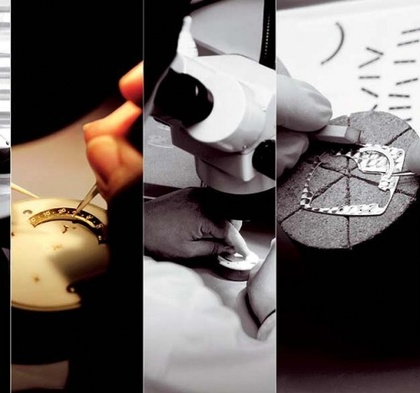
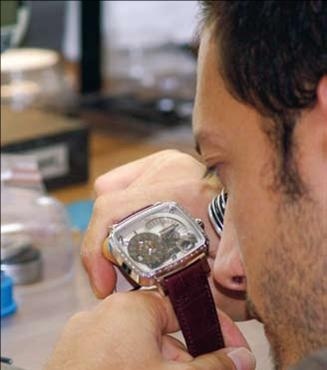
Craftsmen with unique skills and watch making know-how step in to make sure that every part destined for a HAUTLENCE watch is finished in the highest of quality. In all, there are over 40 pieces per movement that pass through the expert hands of these craftsmen, religiously hunched over their lathes or their files and smoothers. Each qualified watchmaker, chosen for his or her outstanding skills, assembles and adjusts the pieces one by one. With a light and assured hand, they mount the pieces and perform the final calibre adjustments. Several tens of hours are needed before the person responsible for this work of art can carry out the final inspection of the piece. Time is of no consequence in the workshops where these tiny masterpieces come to life. Before any collection goes into production, a thorough dialogue occurs between everyone involved in the manufacturing process, from the top-level trio of de Retz, Tetu and Plazenet down to the people who will give shape to the watch- the master watchmakers and their teams- who will handcraft each component that goes in the timepiece share their inputs whilst the only proof that a certain collection exists is its pencil sketches.
Time is of no consequence in the workshops where these tiny masterpieces come to life
It is then run through a CAD (computer aided design) machine that allows a dynamic simulation to be seen. Any refinement before actual conception is done at this stage. Often, other master watchmakers and specialists associated with the company are brought in until a fabrication file is constructed. This ensures a high level of consistency is attained prior to manufacturing the pieces, let alone mountain them onto the watch itself.
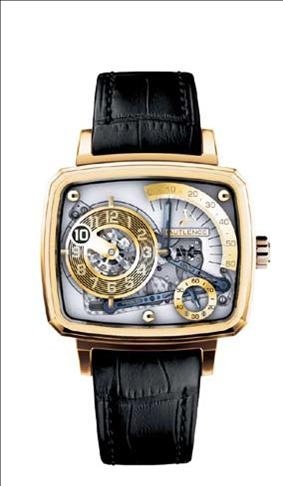
HL01
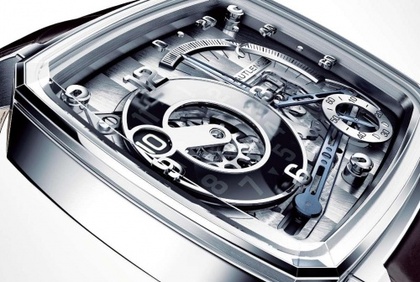
HL05
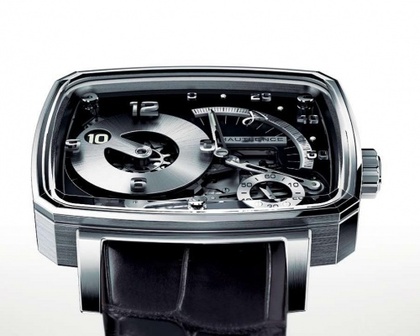
HL06
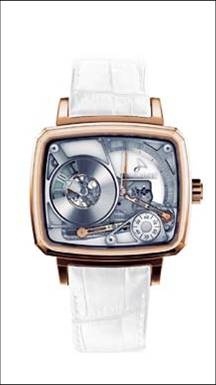
HL07
Only after this arduous process is finished can prototypes begin to be assembled. This step in the stairway to creation allows for a concrete assessment of the product in terms of aesthetics; having an opportunity to touch and examine an actual watch on one‘s hand beats seeing a virtual one, regardless of the image quality and quantity. Each prototype component is milled, honed and forged by the best specialist for that particular part. The finished pieces are then given to the master watchmaker for assembly. Once a prototype is completed, it is turned over to the man known within the brand as the doctor for the start of testing.
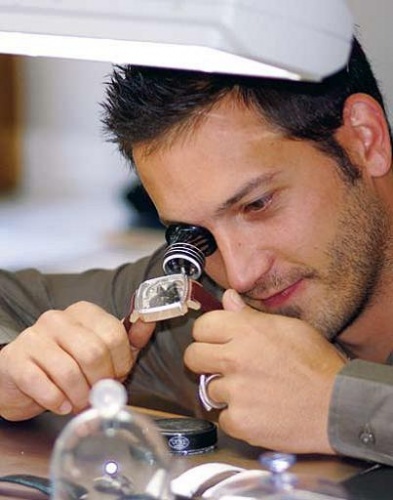
The man referred to as the in-house doctor performs a barrage of test cycles that he himself developed as the unique character of a HAUTLENCE complication required the development of original measurement mechanisms and test parameters. Once past the prototype stage, full-scale production can begin though the phrase can be quite misleading. Only 88 pieces per model are to be produced, each uniquely numbered. Being mechanical in nature, the centerpiece of the HAUTLENCE watch is the movement. The jumping hour of the HAUTLENCE watch is characterized by the use of a decorated jumping disc with an aperture in which the hour numeral, inscribed on a fixed dial, is visible. However, the use of this jumping disc required the resolving of quite a few problems involving energy and inertia. Likewise, the retrograde minute is a more classic complication and like the hour disc, has discontinuous functioning features. This too caused additional complex mechanical problems that needed to be addressed. In dealing with the two dilemmas concurrently, the resulting solution applied led to the exceptional character of the jumping hour mechanism. (SCHEMA 1) This unique and original device developed and subsequently patented optimized energy consumption and the movement‘s torque setting. The cannon pinion (1), the traditional axis of the minute hand, which makes one rotation in one hour, was used as the only organ of movement for the retrograde minute hand (2) and the jumping disc. The jumping disc is not represented in the attached sketch; it is carried by the axis15. The cannon pinion of the minute hand carries a cam(3) that transmits the movement through the intermediary of a sensor(4) -while transforming the movement in a linear shift -to the large rod(5) connecting the reading of hours and minutes. During this movement, the large connecting rod (5) is pushed back and makes the inertia block(7) pivot around its axis(8). The inertia block compresses the spring (6) which -over the course of this movement -gradually accumulates the energy necessary to make the hour disc jump. As the energy accumulates gradually over an hour, the movement‘s barrel spring is solicited regularly and the chronometric performance is not affected. At the end of the hour, the sensor is released from the tip of the cam (9); this allows the spring with its accumulated energy to push the connecting rod back to the right, which brings the minute hand2 back to zero via the intermediary of a secondary connecting rod (10) and launches the inertia block which will act as a fly wheel. After the connecting rod moves back a certain distance, a catch (11) -interdependent with the rod -catches the hour disc‘s primary star wheel (12). Significant effort is needed for the hour disc to be released by the positioning springs (13) acting on the secondary star (14); this sets it in motion. This effort is obtained through the inertia effect of the block which then pivots very quickly.
Each qualified watchmaker, chosen for his or her outstanding skills, assembles and adjusts the pieces one by one
Thanks to its action, the double-star device completes the precise positioning of the hour disc while allowing the large connecting rod to assure the return of the minute hand to zero. With the heart of the watch beating perfectly, attention is then focused on designing a proper exterior to house and show-off the movement simultaneously. Even the technique used to expose the technical elements of the watch is not taken for granted. A tonneau-shaped beveled sapphire crystal glass is fit to the case thanks to its lower lug and reveals the inner levels, seals and flange volumes. The flange is finished by hand to obtain a flank with a silky satin finish. The different levels of display elements beneath the glass give a wonderful in-depth view of the multilevel dial and a glimpse of the mechanical marvel within. The lower dial reveals part of the minute circle and winding mechanism and supports the second flange, which seamlessly floats between the connecting rods and the upper sapphire dial. The hand-fit hour markers and cartridge are visible on the upper dial. The case band is composed of a solid gold body on which the tube and crown are fit. A case back and horns are associated with each case band - one of the main elements of the case -, which is individually crafted by a case artist . The exterior components then receive their punches and finishes, which will make each of the cases a totally distinct piece. The case back is then screwed-on with four specially designed HAUTLENCE screws. The case band is made up of a single vertical surface with a simple machined pit that limits the upper part of the horns. Although the Côtes de Genève adorning the visible surface of the bridges is crafted in other workshops, it is always made in the traditional ways of watch making. Fine concentric or linear perlages are associated with these decorations on a number of pieces. Aside from their decorative aspect, these traditional operations improve the mechanics, the quality of the assembly and the protection of the surface. After the machine work has been completed, numerous hours are required to put the final touches on the pieces. Their surfaces are then treated, leaving them shiny and hard.
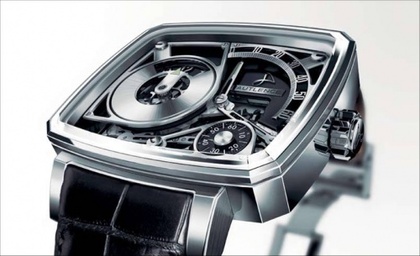
HL08
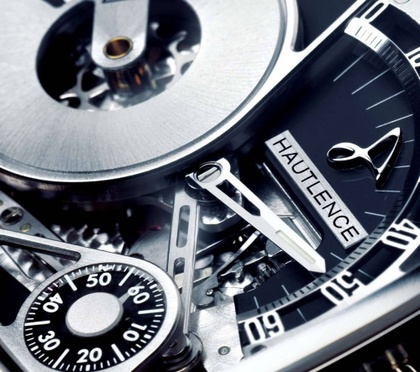
HL08 closeup
The alligator strap provided is cut from high-quality skins and is shaped around a metallic insert to assure excellent hold and integration of the horns. The skin is folded over onto itself and hand stitched. As each timepiece is completed, it is then run through a final series of tests, most notably a five day run through the Cyclotest machine where functional controls are checked and re-checked for the entire duration. Finally, the master watchmaker responsible for breathing life to an individual watch signs the accompanying certificate as a testament to the passion and labor bestowed on it by the artisan. As the production run of a specific model draws to an end, the creative geniuses at HAUTLENCE continue to let their minds push the envelope of mechanical complications to reach new heights. Aside from being at the right place to lift up their aspirations one step higher, life at the EU tech lane seems to
As the production run of a specific model draws to an end, the creative geniuses at HAUTLENCE continue to let their minds push the envelope of mechanical complications to reach new heights.
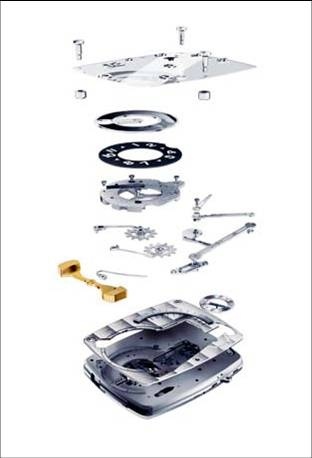
Exploded HL
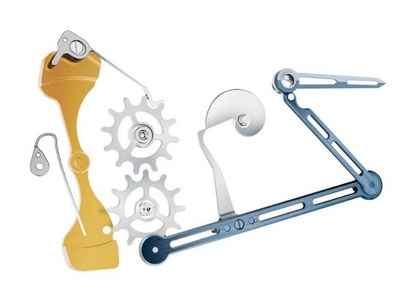
General
HAUTLENCE timepiece with manufacture‘s own calibre. Limited and numbered editions of 88 pieces per model.
Hand-winding mechanical movement.
Jumping hours, retrograde minutes. Power reserve of 40 hours.
Rotation: 21,600 beats per hour. 24 stones.
Caseband dimensions: 43.5 mm
horizontal, 37 mm vertical and 10.5 mm thick. Sapphire crystal glass with angled edges.
Back of the caseband: screwed on with 4 screws, sapphire crystal. Unique numbered timepiece with identification plate.
Buckle: triple fastener folding buckle in solid gold, with cover for adjustment and lengthening, double safety pushbutton or pin buckle in solid gold.
Alligator strap: square scales, skin folded over on itself with metal insert, hand sewn.
Water resistant up to 30 meters (3 ATM).
Movement
(Over 150 components)
Basic works, adjustment and pieces: 7001
Balance: Nivarox Barrel: General Ressort
Shock Absorber: Incabloc
Bridges & bottom plates: brasses
Decoration: perlage , sandblasting, Côte de Genève , anglage. 2N gilding of etchings. Rhodium. Connecting rods: Decorated, nickel plated and PVD treatment.
Jumpers: Durnico machined and cut using thread electro erosion. 550 HB structural hardening.
Springs and steel bridges: Sulem H1. Hardened and tempered. Precision engineering: 20AP steel. Hardened and tempered + electrochemical polishing.
Runner: nickel Star: nickel Cam: nickel + extra-hard PVD surface treatment.
Stones: rubies (NIHS4102 standard)
Screws: hardened, tempered and polished 20AP steel.
Pins: hardened, tempered and polished 20AP steel / NM2 nickel silver
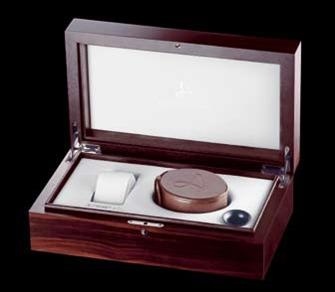
Box
Exterior Components
Tonneau-shaped beveled sapphire crystal glass on the outside surface. Extra-hard multi-layer glare proofing on the inside surface. Sapphire dial: 0.6 mm sapphire plate with 3 holes for screw fixing. Hour marker: laser-cut profile and polished top colored using galvanoplasty. SLN C3 luminescent points.
Hour dial: black varnished. SLN C3 luminescent numerals with white undercoat. Lower dial: milled opening. Hand-applied cartridge setting. Tempographed indication. Galvanic decoration and coloring.
Hour disc: Metallic: snailed aluminum top, visible diamond-set angles / semi-opaque: mineral glass + metal-plating to create concentric bands or smoked glass effect.
Hands: diamond-set facetted; 4N pink gold & rhodium, hammered, blued steel. SLN C3 luminescent point.
INTERVIEW WITH RENAUD DE RETZ
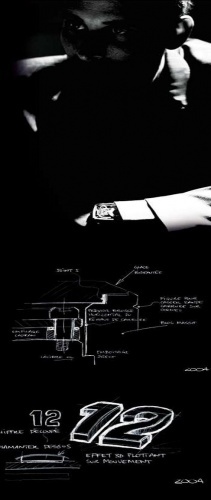
Renaud de Retz & some sketches
What was your background before you decided to enter the watch industry?
I did a business school in France, Madrid and London. Then, I started working directly in the watch industry; in the sales and marketing department at Longines (Swatch Group), Jaeger-LeCoultre and LVMH Watch & Jewellery. I arrived in Switzerland in 2001 and I met my partner, Guillaume Tetu who was working at TAG Heuer, and Rolex before.
Was there one single point, person or event that pushed you to create your own brand?
The main fact that pushed us to create our own brand was the lack of innovation in the watch industry. In Basel 2001, a lot of brands were presenting their novelties only by taking former models of their catalogue, putting 2 or 3 diamonds, changing the color of the dial and for these brands, this was a novelty. For us, it has never been lack that and should never be like that. A novelty has to have a real new philosophy and a new approach.
Why did you choose to enter with your particular type of product? What were your other options? Did you know what you wanted from the beginning or did you just decide you wanted in, with the details to follow?
We chose to enter and start with our own particular philosophy which is: It is the encounter of strong ideas about new approaches to time display and the exploration of mechanical conceptions that can be associated with time display that gave shape to the HAUTLENCE project. Awareness of modern aspirations and the history of watch products; mastery and understanding of the possible benefits of design programmes and computer simulation tools in order to bring the first pencil sketches to life; experience in determining the feasibility of creating a design in terms of materials, means of manufacturing and manpower...
The features of the watches, as well as the desires of the brand‘s creators, made for a strong case for the company to develop its own movements which is a very personal signature.
What has been the most eye-opening or educational thing for you, that you learned after you started that you didn‘t know before?
The most educational thing is that points that are obvious for you as a creator need to be deeply explained to your suppliers, customers and employees. We have to explain a lot what we are doing and where we are going. We feel that we have to educate people to our philosophy that is very far away for the watch making common philosophy ...
Is there one thing or event that best describes what you have gone through to get to where you are now in the watch making industry?
There is one particular event; at a launch in Asia of a new boutique, some other Swiss brands were there. At that time, we did not have delivered yet the first watches. All the other brands found HAUTLENCE entertaining and funny . Then, 6 months later, these same brands discovered the HAUTLENCE watches in the boutiques and were amazed about the work done and some of them were scared for their own market share. But as far as you are following your own way honestly, I feel that there is space for everybody.
What was the best thing about going through all this?
The pleasure of having your babies - your watches! - On the wrist of your customers who are your best ambassadors.
What was the worst?
The delays in the supply chain and production.
Are you happy with what you have done?
More than happy; we are very proud but we still have a lot of things to do. Right now, the first step is achieved and we are already on the second step of our development; for the company and in terms of development of new movements and collections.
Do you know what you want next? What is it? How are you going to do it?
Surprise!...
Calibre Magazine Philippines - words by JP Calimbas