
Miniature air turbines on a wristwatch?
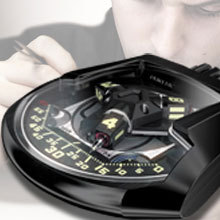
My first reaction on hearing that URWERK's new UR -202 was to feature twin turbines– inspired by minute repeaters of all things– was one of incredulity. Miniature air turbines on a wristwatch? What can a watch with turbines, but without gongs, possibly have in common with a minute repeater? Had URWERK's Felix Baumgartner and Martin Frei crossed over the line between leading haute Horlogerie into the 21st century and leading it down the garden path? A cursory glance at the dial of the new UR-202 reveals little that sets it apart from its groundbreaking UR-201, with its revolving satellite complication and telescopic minute hands. A closer inspection however reveals subtle clues that this is indeed a very different timepiece. On the left of the dial, the new UR-202 features a moonphase indicator instead of the UR-201's power reserve display– an immediate giveaway to the new movement beating within. The day/night indicator on the right gets a make over, with bright blue SuperLumiNova enhanced bands (for night) around the exterior where the UR-201 sported daytime yellow. The more observant may even notice rich-magenta colored rubies guiding the telescopic minute hands protruding from the orbital hour satellites, in place of the UR-201's white Teflon bushes. This is sure evidence that URWERK's research and development into oil-free mechanisms is on going and still bearing fruit.
But the real surprises and differences are to be found by turning the watch over. URWERK has always stated that, while the firm is inspired by the very best in traditional watchmaking, its aim is not simply re-interpreting the past but inventing complications and mechanisms for tomorrow. It was not the minute repeater's striking-gong mechanism, which aroused Baumgartner's inventive curiosity. The source of the UR-202's idiosyncratic turbines originated from a less known minute repeater mechanism, the regulator.Regulation
The usual method of activating a minute repeater is through charging a strike spring by means of a slide on the side of the case. Its all-important escapement precisely regulates the unwinding of a watch's mainspring; however, while the strike spring has no need of a sophisticated device, it needs to be slowed down to a consistent unwinding speed. If the speed is not consistent, the gongs would chime so quickly that they would be indistinguishable from each other. The usual method of slowing down the striking of the gongs is by using an air regulator—in effect a small fan— which spins, sometimes quite noisily, thus creating air friction which, in turn, slows down/regulates the striking mechanism's speed. Turbines
Now, as mentioned earlier, the UR-202 has no striking mechanism. So why the turbines? Well, while superficially similar on the dial side to the UR-201, there is one major difference under the hood: where the earlier UR-201 housed a hand wound caliber, the new UR-202 sports an automatic winding movement. The UR-202 thus becomes URWERK's first automatic timepiece since the inaugural 101/102 models. Naturally, for URWERK, that fact that this is the brand's first automatic movement in more than five years did not stop it from setting about improving the winding mechanism as much as possible. While automatic winding movements provide many benefits.to the wearer, the fact that they cannot be regulated according to the user's activity can lead to increased, or even excessive, wear in the winding mechanism. Another factor with this specific caliber is that it features a highly efficient uni-directional winding system. With the twin turbines of the UR-202, URWERK's goal was to maximize the inherent advantages of uni-directional winding (simplicity, less components to wear), while minimizing wear in the rotor's freewheeling direction. Mission accomplished. By using the same principle of fan blades in a traditional minute repeater regulating the striking mechanism and updating them to the 21st century by using miniature turbines, URWERK has been able to use its research into fluid dynamics to utilize a strong increase in generated air friction to diminish the effects of sudden jarring and jolts on the automatic rotor and winding mechanism. The twin turbines are coupled to the automatic rotor and act in a similar fashion to the shock absorbers on a car. Not only that, the turbine blades are shaped in such a way that they generate lower friction (if desired) when rotating in the direction of winding than they do in the opposite direction when the rotor is free-wheeling, thus minimizing wear. But power is nothing without control. The turbines are controlled by a three-position selector switch which functions by adjusting the level of air compression the turbines generate. The wearer selects the level by regulating the amount of air flowing from inside the case, past the turbines and into a small reservoir. The air/turbine system is totally self-contained within the waterproof case so there is no loss of integrity against dust or moisture. The air flows from under the turbines and is channeled up past them under a sapphire plate and down through holes leading to a tiny air chamber. Two ovalshaped sapphire plates cover each turbine/hole systems and are visible on the back of the watch, as are the spinning turbines. The level of compression is controlled by the three-position selector switch, which operates as follows:
Position 1—extreme activity— both the turbines and rotor are fully blocked. No winding.
Position 2—vigorous activity —the small air chamber is shut off forcing the turbines to compress air into a very restricted space. Limited winding.
Position 3—normal activity —the air chamber is open allowing the turbines to spin relatively easily. Normal winding. The friction of the turbines does fractionally reduce the maximum winding ability of the standard rotor. However, URWERK has left nothing to chance and has compensated for that by adding a few grams more to the rotor's mass. While URWERK's timepieces can (and do) appear to be the last word in ultimate gadgets, all of their horological innovations have a practical purpose. Just as the UR- 202's telescopic minute hands precisely adjust their length to allow for a large easy-to-read dial (when extended) and a short/more comfortable case (retracted), the twin turbines reduce and absorb shocks to the automatic winding mechanism, plus they minimize wear in the rotors free-wheeling direction of rotation. After learning about the new turbines on the UR-202, I now wonder how many more turbines we may see on wristwatches in future. The UR-202 will be available in red gold, white gold, steel and platinum. Those visiting Geneva during the SIHH, might like to check the UR-202 for themselves at URWERK's exhibition at the Hotel des Bergues.By Ian Skellern
2008 INTERNATIONAL WATCH (COVER STORY)
|
The usual method of activating a minute repeater is through charging a strike spring by means of a slide on the side of the case. Its all-important escapement precisely regulates the unwinding of a watch's mainspring; however, while the strike spring has no need of a sophisticated device, it needs to be slowed down to a consistent unwinding speed. If the speed is not consistent, the gongs would chime so quickly that they would be indistinguishable from each other. The usual method of slowing down the striking of the gongs is by using an air regulator—in effect a small fan— which spins, sometimes quite noisily, thus creating air friction which, in turn, slows down/regulates the striking mechanism's speed. Turbines
Now, as mentioned earlier, the UR-202 has no striking mechanism. So why the turbines? Well, while superficially similar on the dial side to the UR-201, there is one major difference under the hood: where the earlier UR-201 housed a hand wound caliber, the new UR-202 sports an automatic winding movement. The UR-202 thus becomes URWERK's first automatic timepiece since the inaugural 101/102 models. Naturally, for URWERK, that fact that this is the brand's first automatic movement in more than five years did not stop it from setting about improving the winding mechanism as much as possible. While automatic winding movements provide many benefits.to the wearer, the fact that they cannot be regulated according to the user's activity can lead to increased, or even excessive, wear in the winding mechanism. Another factor with this specific caliber is that it features a highly efficient uni-directional winding system. With the twin turbines of the UR-202, URWERK's goal was to maximize the inherent advantages of uni-directional winding (simplicity, less components to wear), while minimizing wear in the rotor's freewheeling direction. Mission accomplished. By using the same principle of fan blades in a traditional minute repeater regulating the striking mechanism and updating them to the 21st century by using miniature turbines, URWERK has been able to use its research into fluid dynamics to utilize a strong increase in generated air friction to diminish the effects of sudden jarring and jolts on the automatic rotor and winding mechanism. The twin turbines are coupled to the automatic rotor and act in a similar fashion to the shock absorbers on a car. Not only that, the turbine blades are shaped in such a way that they generate lower friction (if desired) when rotating in the direction of winding than they do in the opposite direction when the rotor is free-wheeling, thus minimizing wear. But power is nothing without control. The turbines are controlled by a three-position selector switch which functions by adjusting the level of air compression the turbines generate. The wearer selects the level by regulating the amount of air flowing from inside the case, past the turbines and into a small reservoir. The air/turbine system is totally self-contained within the waterproof case so there is no loss of integrity against dust or moisture. The air flows from under the turbines and is channeled up past them under a sapphire plate and down through holes leading to a tiny air chamber. Two ovalshaped sapphire plates cover each turbine/hole systems and are visible on the back of the watch, as are the spinning turbines. The level of compression is controlled by the three-position selector switch, which operates as follows:
Position 1—extreme activity— both the turbines and rotor are fully blocked. No winding.
Position 2—vigorous activity —the small air chamber is shut off forcing the turbines to compress air into a very restricted space. Limited winding.
Position 3—normal activity —the air chamber is open allowing the turbines to spin relatively easily. Normal winding. The friction of the turbines does fractionally reduce the maximum winding ability of the standard rotor. However, URWERK has left nothing to chance and has compensated for that by adding a few grams more to the rotor's mass. While URWERK's timepieces can (and do) appear to be the last word in ultimate gadgets, all of their horological innovations have a practical purpose. Just as the UR- 202's telescopic minute hands precisely adjust their length to allow for a large easy-to-read dial (when extended) and a short/more comfortable case (retracted), the twin turbines reduce and absorb shocks to the automatic winding mechanism, plus they minimize wear in the rotors free-wheeling direction of rotation. After learning about the new turbines on the UR-202, I now wonder how many more turbines we may see on wristwatches in future. The UR-202 will be available in red gold, white gold, steel and platinum. Those visiting Geneva during the SIHH, might like to check the UR-202 for themselves at URWERK's exhibition at the Hotel des Bergues.By Ian Skellern
2008 INTERNATIONAL WATCH (COVER STORY)
Marque


