
The quest for increased accuracy from mechanical movements is illogical andridiculously expensive – but it does result in fascinating timepieces like this one
‘Greubel and Forsey...two watchmakers, the lattera Bentley fanatic, who havegone off on a grail-like questof perfecting the tourbillon'
|
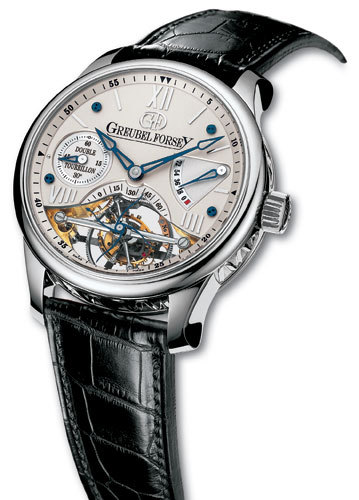
The watch and car worlds seem to attracttheir fair share of – how does one put it –nutters. Take the Koenigsegg supercar. Itonly manages a pitiful 242-plus mph,which is not even four times the legallimit, while at the other end of the scalemy fellow Octane writer Simon de Burtontold me about a man who puts largemotorcycle engines (plural) into Smartcars, bringing them to a level of speed andacceleration that risks making them notjust airborne but put into orbit… Mostpeople who need to travel that fast take the plane, but where is the fun in that?
The same with watches. Extraordinarypeople go to extraordinary lengths to coaxjust that little bit more accuracy out of amechanical movement, at supercar cost(north of £200,000), when in the realworld if you are after pedant-level accuracythen quartz is the only way to go.
Take the example of Messrs Greubeland Forsey: two watchmakers, the latter avintage Bentley fanatic, around 40 (so oldenough to know better), who have goneoff on a grail-like quest of perfecting thetourbillon. The tourbillon, as I am sureevery reader of Octane is aware, is adevice invented to compensate for theeffect of gravity on watches in the verticalposition: a rotating cage housing theescapement (which assists in themaintenance of regular beats). The verticalposition because the tourbillon made itsdebut at the beginning of the 19th century,when pocket watches spent most of theirtime upright in their wearers' pockets.
Nowadays the tourbillon has become ledernier cri amongst some watch brands,but the thinking behind the technologyremains the same as it was a couple ofhundred years ago. Greubel and Forseyfelt strongly that the tourbillon needed tobe brought into the 21st century and theyleft perfectly good jobs at Renaud Papi(a specialist movement maker – a sort ofhorological AMG) and Asprey to provethat a 200-year-old piece of mechanicalsleight of hand, which had been developedto improve the accuracy of unreliablepocket watches, could be updated for theinternet age.
At the beginning of the new centurythey set up their business in the mountaintown of La Chaux de Fonds – the Detroit ofthe watch world – where the nature oftheir work is two-fold. First they developmovements for other brands, which givesthem the income to indulge their passionfor high-class, high-cost tinkering, or asthey prefer to call it ‘inventing'. If notreinventing the wheel, they wanted to dothe next best thing and reinvent thewristwatch.
In the end they have come up with whatthey call double and quadruple tourbillons.The double tourbillon is a normaltourbillon set at a 30° angle to thehorizontal plane of the watch, which isitself set in a further rotating cage – whatGreubel Forsey call the second tourbillon.
Working on the principle that if two isgood, twice two must be better, thequadruple tourbillon features two suchassemblies. They are indeed miracles ofmicro-engineering that are almosthypnotic to watch, and, even thoughproduction of Greubel Forsey pieces runsto just a couple of dozen a year, thebusiness is doing well enough to be expanding to numerous workshops andsites around the town.
Is such a watch really worth getting onfor a quarter-of-a-million quid? Look at itthis way: supercars may go faster, but aGreubel Forsey has lower emissions.
Octane / Février 2007

