
Fade up from black. The void recedes and there you have it… that first moment where the screen hero materializes and speaks. In all the screenwriting books, you're told it's the first words uttered by your protagonist that define him. And having provided this genesis, the words also set up the arc of his evolution in the scenes to come. In the celluloid universe as in reality, language is character. So it was that as a child, Felix Baumgartner, co-founder of URWERK said the word that would come to define him; that would come to jackhammer the fierce outline of his future; and that, in many ways, would set into motion a revolution in the world of high watchmaking. Baumgartner recalls, “My first word was ‘uhr', the German word for clock, not ‘father' or ‘mother'.”
 This world resonated with new urgency in music and art and was presided over by an emerging New Power Elite. This new generation sought out the deep artisan values of watchmaking because it connected them to the innate humanity of luxury. But at the same time they sought to define luxury on their own terms, through the forceful interpretation of new linguistic and visual symbols. And it was Baumgartner who felt he could sing their anthem
The books say that the environment enforces your character's identity and reveals his overriding need. Felix Baumgartner grew up amid a pantheon of watchmaking's greatest achievements. His family home and atelier were lined with clocks and chronometers from watchmaking's Golden Age. They were relics of the 18th century; when horology, that fusion between science and magic, was cherished above all other art. Names like Le Roy, Breguet and Janvier were written across the dials of these chalices of human passion, these engines of fire and collectively, they told him the story of timekeeping. Says Baumgartner, “My father (Gerry Baumgartner) has restored some of the most significant old clocks in history, including the resonance clocks created by Antide Janvier. I grew up around the history of watchmaking.”
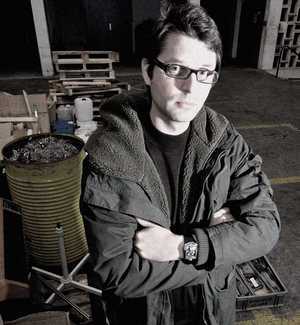
Felix Baumgartner
Had he played it safe, had he followed in the unerring path of unambitious acquiescence, Baumgartner would today be one of the top watchmakers at Vacheron Constantin or Patek Philippe. He would have experienced a steady, metronomic rise to the top of his profession. But having learned at his father's bench the vast mythic secrets of ancient horology, he knew he had to go create rupture. One as profound and personal as the filmic rupture expressed by Godard. Because Baumgartner understood that the world around him was changing, its jaded vernacular fading into dust. And in its place, a new world was rising up: a world of globalization, of non-existent frontiers, of environmental commerce, of war over oil, of new forms of cinema. This world resonated with new urgency in music and art, and was presided over by an emerging New Power Elite. This new generation sought the deep artisan values of watchmaking because it connected them to the innate humanity of luxury. But at the same time, they sought to define luxury on their own terms, through the forceful interpretation of new linguistic and visual symbols. And it was Baumgartner who felt he could sing their anthem.
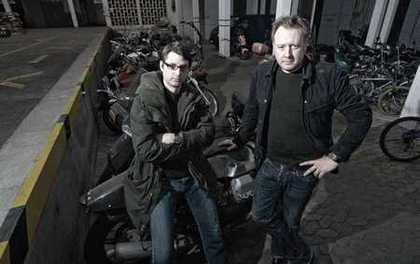
Martin Frei
> BIRTH OF ORBITAL TIMEKEEPING
In the film journey of the hero, the protagonist meets the right people to help him achieve the need burning at his core. In 1995, Felix Baumgartner and his brother Thomas met Martin Frei, an artist and film maker with a flair for sculpting form that expressed velocity with a cool minimalist flair. By this time, both brothers had made a name for themselves working in the grandes maisons of watchmaking's high culture. Together with Martin Frei, they desperately sought the means to transpose watchmaking's traditions of refined finish and artisan values into a timepiece that looks like it has been transported light years from alien distant shores. At the core of their concept was an ancient method of time-telling using a carousel fixed with orbital hour indicators floating beside a fixed minute track. The team had become mesmerized by this form of showing time.
Found in a night clock created in 1656 for Alexandre XII by the Campanus brothers, it offers an appealingly poetic method of representing time, one where there are no hands to chase each other in a perennial reinforcement of time's fleeting nature. Time here was primary… it was naked and bare, and pure. Somehow the minimal nature of the orbital display – where only the precise moment that you are in is shown – was evocative of the Zen Buddhist philosophy of embracing the moment. This message would have huge relevance in the globally tumultuous years to come. But for Felix Baumgartner and Martin Frei, their journey had only just begun in 1995. Over the next decade, they would experience hardship and struggle before ultimately achieving incendiary success.
Why did you setle on the orbital hour display as your signature focus?
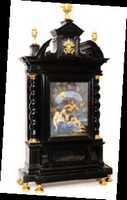
MF: We met in Zurich and they showed me their indication of time based on this 17th century design. At first, I didn't understand the indication, but once they explained it to me, I realized how simple it was. I really liked this contrast of an object that appears almost intimidatingly complex at first, then when you know its secret, it is enchantingly simple. For me, the original concept of URWERK was related to minimalism, how little we could show to give a reading of time. So, our first two watches have a very strong minimalist feel. We took advantage of this indication to have a huge expanse of space for the case, which was purely material with no indication, except at the very top. It became like a time-telling sculpture.
You augmented the orbital hour indicator using Maltese crosses that vastly improved its function, is that correct ?
FB: We studied the mechanisms that were used in orbital clocks and we discovered that they all used stars inside of the satellites to get them to rotate. This is exactly the same type of mechanism used by Audemars Piguet in their Star Wheel watches. The problem with the star is that you need a spring to drive it. And this spring takes quite a lot of energy, so you have a drop in the watch's amplitude each time it changes hour. Also, when you set the time too quickly, the star can jump more than once. So it was our idea to change the star to a Maltese Cross. There are several big advantages to this. A Maltese Cross doesn't take energy when it changes hour, and you cannot make it turn forward twice.
> POP CULTURE MEETS HIGH watchmaking
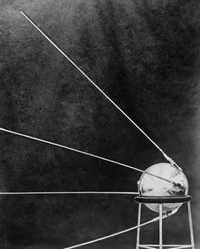
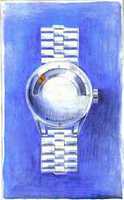 FB: Martin made a lot of drawings and the one I liked best became the 102. I saw it and I said, “We have to do this.” It's interesting because the designs that Martin likes use rounded forms, but are always cut by very hard lines. And if you think about it, this is sort of a universal expression for speed. Whether you are looking at Ferrari's new 599 or a WallyPower yacht, the recurring means for invoking velocity in a man-made object uses this contrast of an organic form cut by hard lines. The 102 was inspired by the Soviet satellite Sputnik while the 101 was inspired by Han Solo's Millennium Falcon from the film Star Wars.
MF: It was important to stress the asymmetry of the watch. If we were going to have the time indication on only one side, then it was important to style the opposite side of the watch differently; to make almost a small animal out of the case, then give it a sense of head and tail, which again emphasizes speed.
FB: We are not businessmen; we began essentially as a core group of artists who wanted to interpret time differently. You can't do something this radical as a businessman because in that context, you can take some risk, but not risk everything. You want to have some assurance that your products will be accepted. For us, we really went to the extreme of risk because we had no idea how our watches would be accepted. When we first launched our watches in 1997, people essentially thought we were crazy. But we wanted to bring something original to watchmaking. I come from three generations of watchmakers and I knew I couldn't keep repeating the past. We had to build something new on the
solid foundations of the culture I was born into.
> LEAN YEARS
When did you launch your watches and what was the reaction ?
FB: We launched both the 101 and 102 at the AHCI stand in 1997. When you do something with a lot of passion, you feel great when people react strongly to the watch. We had people saying they thought it was great, but only a few bought it.
MF: That was a hard year. The first time we presented the watches, we placed them on heating plates that I thought looked really cool. It was a bit like installation art, but the watchmakers were very upset by this because they felt it wasn't horology.
 How did the brand survive ?
FB: From time to time, we were doing special commissions like the Rothschild watch. We were commissioned by someone from the Rothschild family to incorporate the five arrows from their family coat of arms into a watch.
Any other pro jects ?
MF: Another idea that we had was to make a sort of salon table that incorporates a three-dimensional astrolabe. At some other point, the people building a very exclusive hotel in Dubai said they wanted us to include a kind of spaceship-like desk clock that was integrated in the wall, and that emerged when you wanted to use it. The clock actually had a projector beam that would shoot the time up on the ceiling. But this project was abandoned.
How did you survive ?
FB: I worked on one very interesting movement for Vacheron Constantin. The entire movement was held in place using ball bearings. Only the balance and the anchor used rubies. I remember being fascinated by this movement and, perhaps, it was at this point that I became interested in using ball bearings in our complication.
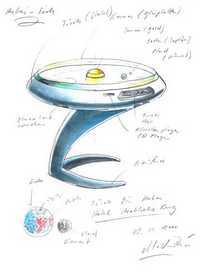
the people building a very exclusive hotel in Dubai said they wanted us to include a kind of spaceship -like desk clock that was integrated in the wall, and that emerged when you wanted to use it. The clock actually had a projector beam that would shot the time up on the ceiling
MF: I remember around this time, I would go over to the Baumgartner's atelier and we had a original 45 of the Rolling Stones' Time Is On My Side and we would play it over and over again to keep us inspired, to keep us going. Sometimes, we were depressed, saying how difficult it was to continue when you have absolutely no money. But then we would start talking about the watches and the passion would fuel us. It would fill us up and we would always end the evening feeling hopeful and believing in the future.
> THE GOLDPFEIL PROJECT
Why did the Goldpfeil project fail ?
FB: The concept of the Goldpfeil project was that there would be seven members of the Academy who would unveil their watches simultaneously. But when it came time for the launch, only three of us were ready. But honestly, I felt that the amount of time given, which was six months, was not really sufficient to conceptualize, construct and build something really original. This was why we decided to do something very simple, so that we could ensure that we were on time. Goldpfeil decided to put millions into the communication and marketing of this project, but maybe not enough into the product itself. The Goldpfeil project kept us afloat. Business was really not what we'd hoped and we were in something of a depression. We thought that maybe we couldn't make URWERK run on its own. So, at that time, we put a lot of hope and aspiration into the Goldpfeil project. At first, there was so much excitement about the project, but then it all quickly fell apart. I have to tell you, at this point, our morale really hit rok bottom. It was as if we were always just so close to success, but never making it.
Were you paid for all your efforts ?
At first, we weren't paid. Then, in 2002, they ended up paying us by accident, because they had intended to pay someone else and accidentally sent us a check for the money we were owed. So essentially, at this stage, we had exactly 100,000 Swiss Francs operational funds for our company. And we all sat in this room and looked at each other. We had done the 101 and the 102, and we had already started designing the 103 to incorporate my father's idea of placing the time indication on the bottom of the watch. We asked ourselves the big question, “What should we do with the money? Should we shut down the company? Should we all take a big holiday? Are we too burnt-out to continue?” And in the end, we all looked at each other and decided to push on. We believed in our hearts that URWERK had a reason to be and that surely, there were customers out there who were fans of true watchmaking, but wanted it to be defined in new terms. There had to be people who shared our vision. So instead of playing it safe, we took a huge gamble by sinking every cent of this money plus my entire savings of 40,000, which I made working at Vacheron Constantin.
 > BREAKTHROUGH – THE UR 103.01
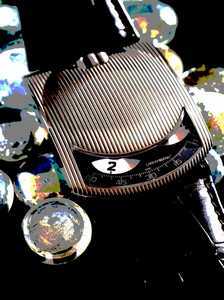
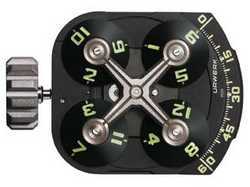
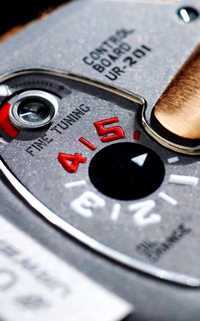
In 2003 after enduring 6 years of hardship and struggle, URWERK unveiled the 103.01 a watch that Baumgartner and Frei had sunk all of their life savings into creating. The phenomenal gamble paid off. Word began to spread of this timepiece that electrified critics and consumers alike. The 103.01 differed from the UR 101 and 201 both of which used two satellites fixed to a larger carousel. In the 103 series an ultra light titanium orbital cross bears four hour satellites each bearing three hour indices. Satellite one is engraved with the 1, 5 and 9 index, satellite two bears 2, 6 and 10, satellite three bears 3,7 and 11 and fourth and last satellite bears 4, 8 and 12. Each of these indices is engraved at an inclined angle so that users can check the time as it orbits at the bottom perimeter of the watch along the minute track without shifting their wrist position. This also holds true for checking the time while driving with your hands on the steering wheel of a car. The UR 103 series were also the first URWERK watches to feature control boards integrated into the watch backs. This offered readings for power reserve, precise minutes that were synchronized to the front side carousel and an externally accessible fine regulator that could allow fine tuning of timing precision without having to open the watch. The UR 103 was revelatory, combining science fiction with the fluid drama of Umberto Boccioni's futurist sculpture with innovative time telling expressionism and a vast array of interactive functions.
When did you decide to shift the time-teling in dication to the botom of the watch, as seen in the UR 103?
MF: Initially, we were doing all the indications on the top of our watches and it was actually Felix's father who said, “Why don't you invert it?” If you put the indications at the bottom edge of the watch then people will be able to read it when they have their hands on the steering wheel
when driving.
This watch has a fantasticaly complex case . can you elaborate ?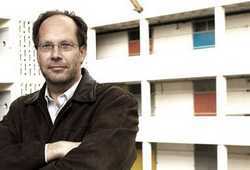 FB: We met Christian Gros when he fabricated all the cases of the Goldpfeil watches. We were really impressed by what he could do with his five-axis CNC machines and this gave us a great deal of liberation in the design of the 103. Here was a very pure, strong shape that was also very complex to execute. After he made the 103, Christian explained that this was the hardest case he ever had to make, and he had made the case for the Opus 3! The development cost for developing the case and the sapphire glass was huge. The sapphire glass is curved on two axes, which was considered impossible at that time. Every cent we had went into making the first series of five 103 watches, which were made in steel. We were by no means certain that this watch would be embraced because we had little success with the 101 and 102, and because, this time, we had created a super crazy watch.
 How was the UR 103 received?
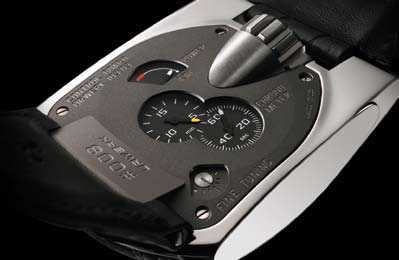
MF: When we launched the 103, maybe the market had evolved and maybe our vision had also matured. But it was the first time people really took us seriously. I remember that they were initially fascinated by the three-dimensional inclination of the satellites, but what hooked them was when they turned the watch over and saw the control board.
What was the chalenge with this watch ?
FB: Creating the carousel mechanism was far more challenging than anything we'd done before. It is 160 times heavier than a pair of traditional hands, so we used titanium and aluminium to make it as light as possible. As a watchmaker, it was a big challenge for me to get this mechanism balanced for it to rotate smoothly and be dependable. Today, our watches are amongst the most challenging to assemble because of the balance needed for the carousel.
Where did the idea for the control board come from ?
FB: The idea for the control board came from a marine chronometer, where you had many different types of information that are functional but not used all day, so we put them on the back. So you see, again, we have done a modern interpretation of classic horology.
MF: I like the idea of the control board telling you the condition of the watch. It's almost like an information center that monitors your watch's health!
Why did you place a screw on the board that allows people to adjust their watch to run faster or slower ?
FB: The self-regulating feature comes from Abraham-Louis Breguet, who put them on his pocket watches. It gives the wearer the opportunity to interact with his watch. The other benefit is when you bring your watch in, for example to get the strap changed, the watchmaker can do a quick adjustment for timing accuracy without having to open up the watch and compromising the water resistance.
Are you concerned that people will damage their watches using this ?
FB: No. The mechanism is built such that you can turn it 50 times in one direction and it will not do any damage to the watch. There is a fork and an ex-center piece coming into the fork. So even if you make a complete revolution to the ex-center, you still only affect the timing by so much.
Four years after it was launched, the UR 103 is still as fresh and vibrant as ever. What's the secret to its longevity ?
MF: We are now in a period where people are making increasingly wild “machines” that can be strapped to the wrist and worn as a type of horologically related jewelry. But for URWERK, it was always important to be respectful of watchmaking's history and we respect the human anatomy in the way we design watches, because we understand they must be worn. The 103 is a big watch but when you wear it, it is very comfortable, and I like this contrast of something very futuristic-looking that ends up being surprisingly interactive with the human body.
Who played the bigest role in the succes of the UR 103?
FB: John Simonian, the owner of Westime in Los Angeles, played an instrumental role in the success of URWERK. He was really the first to back us up with an order that expressed his confidence in the brand. Pierre Halimi, a US watch distributor, introduced us to John during the 2003 Basel Fair. He took a look at our watch and then he placed an order for 14 pieces of the 103. We almost fell out of our chairs. For us, it was a really incredible and very emotional moment. We had struggled for so long and when John placed this order, to a large extent, we felt things were starting to change for the better and that at long last, people understood our vision for high watchmaking.
> WINDOW TO THE INNER WORLD - THE UR 103.03
Was there some initial resistance from Martin to put a glas top in the UR 103?
FB: You have to understand that the original idea of URWERK was to make a watch that was very pure, very stark and, somehow, very minimalist, so we did not think for sometime about revealing how the orbital hour indicator worked. But my question to Martin was how we could show the huge effort we put into the carousel. I guess I was thinking like a watchmaker. I do the work that goes into the watch, so it's natural that I want people to see the technical effort within. At first, there was some resistance because this went against the artistic minimalism of the brand. But then we realized that by fabricating a large part of the watch in sapphire, you also create a largely scratchproof case, and this gave us a functional impetus to proceed.
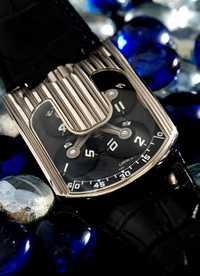
MF: Once I got past my resistance to the idea, I started to think about how to open up the case and I started to find it quite appealing because you are taking functional elements and giving them an aesthetic significance. Felix was right, once we opened it, you could see people's eyes gravitating towards the watch, drawn there by the unique appearance of the mechanism.
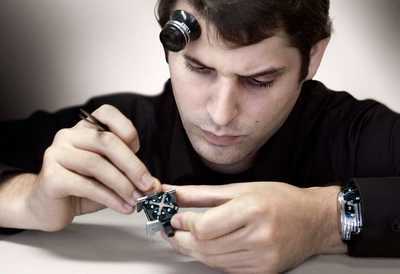
"I guess I was thinking like a watchmaker. I do the work that goes into the watch, so it's natural that I want people to see the technical effort within" Felix Baumgartner
Your next watch would take the orbital complication one step further even than the Opus 5, corect ?
FB: We really try to stretch the definition of “complication” with our orbital expressions of timekeeping. I have a huge amount of respect for Richard Mille. He is a real innovator with regards to style, design, new types of indications such as his torque indicator, and the reinterpretation of luxury using lightweight watches, but his watches feature traditional complications like the rattrapante or the tourbillon. We want to make the type of watches and ways of interpreting time that have not existed before. We did this with our next project, the Hammerhead!
> THE CRITICAL SMASH – OPUS 5
How did you become involved in Harry Winston's Opus Project ?
MF: In 2003, someone from Harry Winston came to our stand at Basel. He liked our watch so he invited us to the Harry Winston booth to meet Max Büsser. Max was, as he likes to say, “really blown away” by the 103. We decided to conceptualize the Opus 5. Initially, the agreement was for a watch we codenamed the “Time Bandit”.
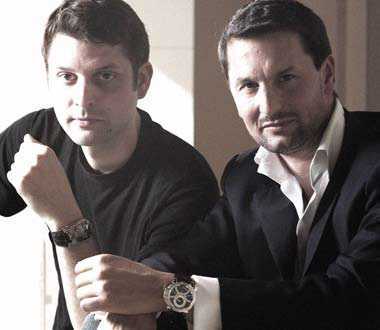
Felix Baumgartner & Max Büsser
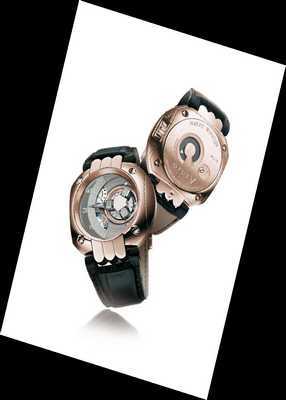 Did this have anything to do with a slot machine ?
FB: Yes, you had to arm it like a slot machine. The time indications were placed on cylinders. But the watch never showed the time until you armed it. Once you released the arming lever, these cylinders would turn until they stopped precisely at the right time. It was a completely crazy idea. In fact, the base of this watch was essentially a minute repeater. You had a time-telling base caliber, then a system of snail cams and racks like that found in a minute repeater. When you armed the watch, you would essentially be arming something similar to a strike barrel. But instead of translating the time into hammer strikes on gongs, they would operate this one-arm-bandit-like indication. And this indication involved a whole additional mechanism. When conceptualizing the watch, we were joking that we were gambling with time, because we didn't know if it was possible to create it in a little over one year. This proved right.
> CHALLENGES
you ultimately cancelled the project, corect ?
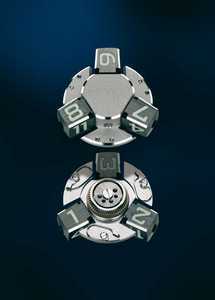 FB: Yes. Because the watch was so complex to produce, I had huge concerns about its functionality. What I didn't want was to create something that looked impressive, but then became a source of frustration to its owner because it was so delicate. As a watchmaker, you need to be truthful about how functional and reliable the watch you are creating is. Anyone who buys an incredibly expensive complication and then has nothing but problems with it may be put off horology forever because of this nightmare. For me, a true complication must be wearable; it must work and you must be able to wear it everyday. It is a very difficult thing to say that you think a crazy idea is not going to work. Before we went to see Max, we knew we had to come up with an equally mind-blowing alternative to the Time Bandit!
Is this when the three-dimensional pyramids comprising the Opus 5's hour indicators emerged?
MF: Yes. The alternative idea came from a drawing I made of a watch with hands shaped as three-dimensional cones that rotated at 90 degrees to the central rotational axis.
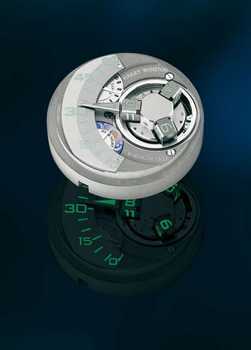
How did Max Büsser feel when you told him you had to drop the Time Bandit ?
FB: Martin and I went to his office in Geneva and we told him, “I'm sorry, but as a watchmaker, I don't think it's safe to proceed in this direction.” He looked at us, swallowed hard and said, “OK.” Max Büsser loves horology and also respects it. He understood the realities of coming up with a truly innovative timepiece and pushed us to do our best work. We showed him different concepts and one of them was this watch with the three-dimensional cones at 90 degrees. He immediately gravitated to this idea. I had, by this point, added the huge retrograde indicator as a kind of marriage between Harry Winston and URWERK as retrograde indicators are a signature element of Winston's watches. (Harry Winston created the world's first double retrograde perpetual calendar.)
But this was no more retrograde hand, corect ?
FB: This hand was a big achievement. It doesn't simply pivot on one point, but it follows a track on the perimeter of the carousel. I had to learn how to fabricate a special coiled spring that is 5/100th of a millimeter in diameter to load the hand, and I used ball bearings to allow the hand to slide freely on the track.
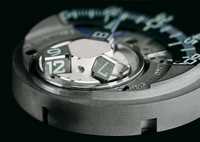
Opus 5 is often considered the most stunning of the Opus watches, did its success help promote your name ?
The Opus 5 and its big critical and commercial success really helped bring our name to a wider audience. At the same time, the independent success of the 103 range of watches was also propelling us forward. Now, we had a sense that people really embraced the philosophy of URWERK.
> DARKEST HOUR
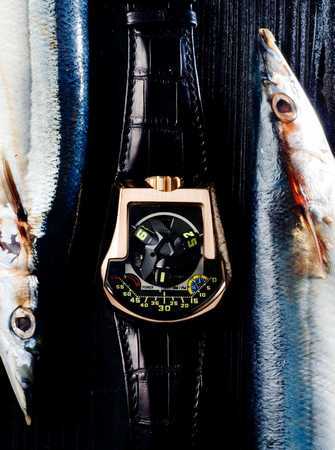
The company went through some personal changes during this period, is that corect ?
FB: During the period — late 2003 — when I told Max Büsser that we had to completely change the Opus 5, my brother Thomas became very sick and he had to leave the company at the end of 2003. Thomas had previously handled all the business and communication of the project. It was really a big emotional blow for us. I have to really commend Max Büsser, he continued to have confidence in us and, in some ways, his confidence gave us some inspiration. John Simonian was also concerned because he had made the single largest order we had ever had. At this time, Martin was still primarily working as an artist and I told him that we had to go see our clients and explain the situation to them. We started to visit our clients and when we went to see people like John or Max, we were really touched that they gave us so much confidence. After six months, we were back on track.
MF: From my point of view, I got to know Thomas first, then I got to know Felix. But at some point, every time I came to Geneva, I realized that Felix was handling more and more. He was stressed during this period, but he handled it very well. I have to say I am proud of him.
FB: (Laughs) I am naturally a stressed guy. I've never had a really traditional job. I've spent my whole life working as an independent watchmaker and I am grateful that I have this energy to go further. There is something within me that compels me to always do more.
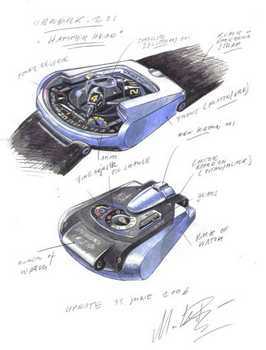 > BIRTH OF THE HAMMERHEAD
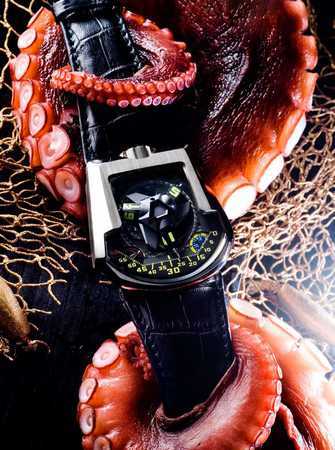
The first sketches of the UR 201, codenamed “The Hammerhead”, revealed a squatter and more hyper-aggressive-looking watch case than that used in the 103 family. They also revealed the intention to take the concept for the revolving 90 degree hour satellites, first seen on URWERK's collaboration with Harry Winston on the groundbreaking Opus 5, to a higher evolution. From its inception in 2007, URWERK's signature visual flourish has been the use of floating hour indicators, where time is told by satellites that drift beside a fixed minute track. In the UR 201, the brand completely exploded the boundaries of this type of indication, to boldly tread where no one has gone before.
On the dial-side of the 201 is a very wide arc dial with a 50-hour power reserve indicator on the left and day/night indicator on the right. Here, three hour-satellites – as compared to four in the UR 103 – allow the 60- minute scale to be read over a larger and easier-to-read 120-degree arc. As each hour satellite descends, a telescopic needle inlaid with luminous material emerges from inside the satellite. This telescopic minute hand constantly changes length over the irregular arc of the minute track to maintain a constant distance from the luminous minute markers. Once past the 60-minute mark, the telescopic hand instantly retracts like the blade of a stiletto knife.
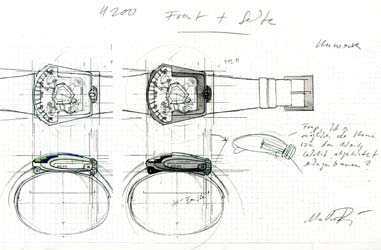
Martin Frei's twin inspirations for the UR 201 are clearly evident : the Wally Power high performance super yacht is seen in the crisply ironed edges and angular flat planes of the case , while the hamerhead shark's cranial silhouete is reflected in the shape of the sapphire crystal
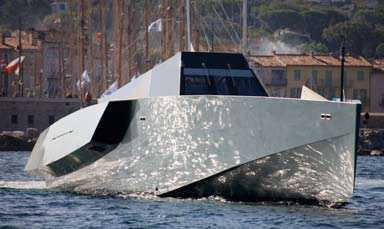
URWERK's designer Martin Frei's twin inspirations are clearly evident: the WallyPower high performance super yacht is seen in the crisply ironed edges and angular flat planes of the case, while the hammerhead shark's cranial silhouette is reflected in the shape of the sapphire crystal. Overall, the watch is more reminiscent of a miniaturized high-tech military assault craft than a high-end timepiece.
How did the Hammerhead come about?
FB: I wanted to have a bigger brother to the 103 very shortly after we launched it. Something like the Time Bandit was cool, but there was not enough of a connection to our identity. Even before we created Opus 5, we brought three-dimensional satellites into our own model range. Opus was an important watch because it fulfilled our creativity and demonstrated that there was a market for a really original concept for timekeeping.
Wasn't it quite intimidating to create the successor to the successful case shape of the UR 103?
MF: This was definitely a challenge, but as a designer, this is also where the process becomes fun. We had established a great deal of critical impact with the 103 series and also Harry Winston's Opus 5. For the next watch, we needed to do something that was different; that represented an evolutionary stage, but was also immediately recognizable; and that expressed the cannon of our ideology. But the most challenging thing is to transition from emotion into execution; to give shape to your feelings. We had one iconic model, but we knew we had to develop a second model that expressed the URWERK DNA. The Hammerhead encapsulated the years of ideas.
> ALL-NEW ORBITAL COMPLICATION WITH TELESCOPIC MINUTE HANDS
Where did the idea for a telescopic minute hand come from ?
MF: Long ago, I had an idea that the duration of an hour for the hour indicator could be a period of play. It should be a celebration for that one specific hour in life and you should have on your watch something exciting, thrilling and engaging to represent this. It's a bit like each hour is a person hooked to a ski lift, and when it brings you to the top, you disengage from the lift and enjoy yourself before returning to the lift.
So, what we decided to do was to create a minute indicator that was unique and interesting. At one point, we were thinking of doing a minute hand that flipped open from the side like a switchblade knife. But I liked the idea of a pantograph and how the needle follows a line. So, we decided to create a kind of hand that could expand and contract following the lines of the minute track.
FB: What was needed was for the needle to retract when passing 60 minutes because otherwise, it would jam against the side of the case unless you expanded the inner space dramatically, which would make the watch unwearable.
 How exactly does the minute hand expand and contract with such precision ?
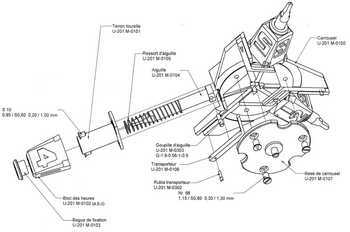
What is important to know about this indication is that while it looks simple, it is hugely complex to create. Because of the irregular curve of our minute indicator, the minute hand continues to expand and retract throughout the entire 60-minute period that it is visible. We had to calculate 360 points on the minute track and use these to create a special profile cam, which you see positioned below the carousel mechanism. You have a hidden control arm/transporter that traces the pattern of this special cam and simultaneously controls the springloaded contraction and expansion of the telescopic minute hand to always maintain a uniform relationship with the minute track.
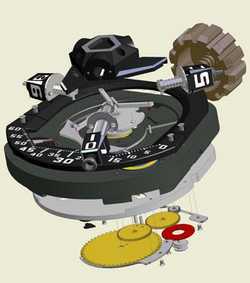
The cam is the element that receives the perlage decoration. Then on the carousel, you have these additional ninja-star-like protrusions. Underneath these protrusions is the transporter mechanism for each satellite. The transporter cam undegoes a special MOVIC surface lubrication treatment. The arm of the transporter is in titanium to keep it as light as possible and the needle that contacts the cam is made from steel. You can see in our sketch the calculation we made for the shape of the cam. It took us over one year just to get the calculations of the cam, and the retracting minute hands to work correctly. There were many different solutions for making the telescopic hand, but we wanted to make a watch that was extremely reliable. So, the transporter traces the shape of the cam below and in turn pushes in or releases the telescopic minute hand, which is loaded using a very small diameter coiled spring. I learned to make this kind of spring when I was working on the retrograde indicator on the Opus 5. The goal was that the whole complication would function without oil. In the end, I placed a tiny amount of oil between the cam and transporter. But the entire carousel mechanism and all the hour indications function completely without oil.
MF: If you think about it, the transporter mechanism is a bit like something you would find in the old automatons where you would have a robotic figure that could write words. This is not unlike the mechanism we've created.
FB: The challenge is that the cam has to be calculated really precisely to allow the minute hand to change lengths. But the cam's profile also had to be really smooth so as not to generate too much friction. If you have one point where there is just a bit too much friction, you could actually stop the forward progression of the carousel. Further, when machining these pieces, we were dealing with really precise tolerances because the smallest deviation could affect the position of the hand.
For the first time, there are small touches of color in your watches …
MF: In the end, we are quite proud of the work we did with Opus 5 and so we took the day and night indicator that we created for this movement. This adds a small touch of warmth and color to the watch.
FB: If you look at the back of the watch on the control board, you'll see that there is also a service indicator. Here, it appears as an oil change indicator, which is a functional indication because what do 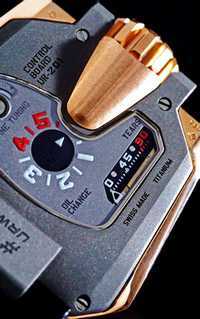 you do when you service a watch? You re-lubricate it. That is the principal goal of the service because, here, regulation can be carried out largely through the external regulator device without compromising the water resistance of the watch.
Then, we have an indication that shows the running time of the movement. This indication does not take energy from the movement, because the indication is driven off the ratchet wheel. When you wind the watch, you will also activate this indication.
FB: We've been working on this watch for three years and I have to say that it's the very first time I've been super happy with the result from the moment we finished the watch. We are a young brand and so we want to build and solidify our identity based on the orbital complication before we come out with new complications. But we have a huge amount of ideas in terms of the kind of watches we want to do. But at the same time, we will continue with the 103 family, which has sort of become the iconic range of watches for us.
Source: Revolution may 2007


