Une Richard Mille se mérite, non seulement au moment de l'achat (plusieurs centaines de milliers d'euros), mais aussi au moment de la révision (plusieurs dizaines de milliers d'euros) : démonstration de l'excellent Nick Foulques dans un article de Newsweek (en anglais).
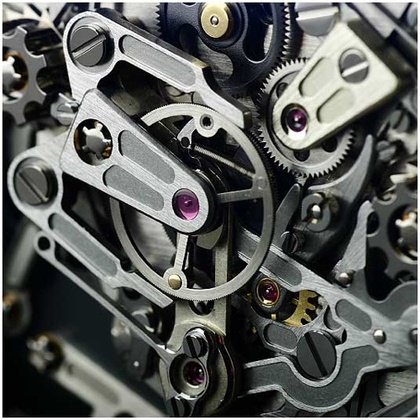
Richard Mille RM 008 (image Luc Virginius)
LECTURES D'ÉTÉ : tout est bon pour que les amateurs de luxe paient toujours un petit peu plus : c'est ça, le goût de luxe !
Une Richard Mille se mérite, non seulement au moment de l'achat (plusieurs centaines de milliers d'euros), mais aussi au moment de la révision (plusieurs dizaines de milliers d'euros) : démonstration de l'excellent Nick Foulques dans un article de « Newsweek » (en anglais).
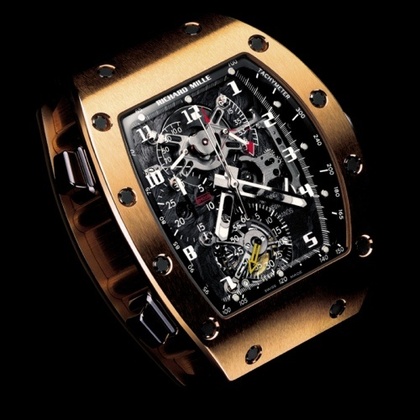
Richard Mille Tourbillon Chrono Rattrapante RM 008
For Whatever It's Worth
Luxury companies are always finding ways to get consumers to spend more.
Often when I wander down the world's great shopping streets, I silently curse the concept of shareholder value. It always seems to me to come with an expectation for constant growth, and for this, luxury companies need to find ever more ingenious ways of getting us to spend more.
There are some brands that achieve this almost effortlessly. For instance, the other day I strolled into my local branch of Hermès and examined some of the cute crocodile-skin ring-binder diaries: small things a few inches square with a nice silver pen slotted into the side. I was delighted to see that the more expensive ones were heading north of £1,500.
The fact that I was only mildly surprised by this price tag testifies to the power of the Hermès image and its reputation for quality and style. Being charged a considerable sum for a small and beautiful object has a value to the customer; it offers reassurance that this is indeed a serious purchase. And to be taken seriously you have to take yourself seriously first. I left Hermès with a renewed respect for crocodile-skin mini-agendas.
Other industries need to work harder to get us to spend more. The luxury-fashion world has attempted to achieve this by creating new seasons. The old days of simple summer and winter seem almost prelapsarian in their innocence. Today the cruise collection, filling an alleged interstice between winter and summer, has been joined by pre-fall; add to that the theme of manufactured rarity demonstrated by the seemingly endless capacity for limited editions, and one wonders how many more reasons can be invented to buy a handbag or a new pair of pants.
The creation of new levels of quality is, to me at least, a more sustainable idea. For those who progress beyond the bulimic thrill of buying more and more to the self-satisfaction of buying better and better, some global brands have added a new level of experience: bespoke service. For instance, Armani has given its male customers Fatto a Mano su Misura—which roughly translates as made-to-measure—suits from about £5,500 apiece. The combination of a bespoke garment made by a world-renowned brand creates a double-barreled blast of adding value.
Ownership of exclusive items, however, brings a new set of responsibilities—and costs. Good wines have to be cellared, fine cigars need to be humidified and Italian sports cars require careful servicing. And the owner of a Richard Mille RM 008 Tourbillon Split-Second Wristwatch, for instance, has to scrape together an average of £10,000 or so to get it serviced—on top of the £300,000 purchase price.
Some companies have figured out how to add value simply by using ever more rarefied raw materials. Loro Piana, a generations-old cloth merchant, peddles exquisite cashmere garments at its stores. But for customers seeking a superior alternative, Loro Piana introduced baby cashmere, the first combing of a baby goat—a once-in-a-lifetime event—that yields 30 grams of ludicrously fine cashmere. But you need to comb about 20 young goats to glean enough cashmere for a sweater, which naturally requires customers to pay a premium of 50 percent more than for average cashmere. If that is still too affordable, Loro Piana has spent the past 12 years working to reintroduce vicuña, a soft, light, warm cloth that the Incas used to call the fiber of the gods. It is much rarer than cashmere and five times as costly; a Loro Piana vicuña "icer" winter coat sells for £8,365.
Ours is an information-saturated age. If we don't know what to pay for something, the great online bazaars and souks of the world can give an approximate valuation in minutes. It's only those things that are so exotic or sui generis as to defy pricing that acquire the kind of value for which their creators can charge pretty much whatever they want. Now I am off to Hermès to see if I can beat it down on the price of that pretty little crocodile-skin agenda Nick Foulkes Foulkes has written extensively on luxury and is the author of several books, most recently "Dancing Into Battle: A Social History of the Battle of Waterloo." Look for his monthly columns on luxury in NEWSWEEK's "Good Life" section.

SOURCE : Newsweek, 15 août 2007 (cliquez sur la vigogne ci-dessus)…